

By Ketan Mane, Ph.D., Director, Digital and Artificial Intel Solutions
Federal agencies are moving quickly to put AI to work, but as adoption scales, so does a less glamorous concern: the cost of running it.
Large language models (LLMs) can bring powerful capabilities to federal missions, but relying on the largest available model for every task is an expensive way to build an AI ecosystem. Every application programming interface (API) call consumes resources. Every token carries a cost. At enterprise scale, those costs add up quickly to frequently stall promising pilots before they can achieve full production deployment.
Consider an intelligence analyst reviewing hundreds of reports to identify emerging threats. AI can help surface relevant information faster, but routing every document through a large, expensive frontier model can quickly consume finite resources. A more deliberate approach will be to reserve advanced models for processing information that requires complex reasoning, helping the analyst focus on actionable intelligence while keeping operational costs under control.
Default approach
Every report goes to a large frontier model
Expensive compute used for simple tasks
Higher potential operational costs
Mission-aware approach
Routine reports use smaller models
Advanced compute reserved for complex reasoning
More efficient resource allocation
Agencies can achieve greater mission value by making informed decisions about where, when, and how they use AI. That starts with an architecture designed around operational needs.
Stop Defaulting to Brute-Force Compute
A frontier model may be valuable for complex reasoning, but the truth is many everyday workloads do not require one.
Routine triage, document processing, summarization, and simple search can often be handled by smaller, highly optimized models or purpose-built capabilities. Sending those requests to a large external model can consume budget without producing additional mission value. Small Language Models outperform massive frontier models on domain-specific tasks while operating at a fraction of the cost.
Therefore, cost-efficiency needs to be engineered into an AI environment from the beginning. It belongs alongside accuracy, latency, security, and compliance as a core design consideration.
In other words, optimized AI use is less about finding one model that can do everything and more about matching the right capability to the right workload.
Vertical Intelligence Makes AI More Mission-Aware
Vertical intelligence can help make this optimization possible by bringing mission-specific knowledge, terminology, and context into an AI system so it can operate effectively within a particular domain. For federal agencies, that can include specialized policies, data taxonomies, and operational context that general-purpose models were never trained to understand.
That deeper context can also make AI more cost-effective, because agencies no longer need to rely on expensive general-purpose models to repeatedly interpret specialized information from scratch. Instead, they can build domain knowledge into the AI environment and use specialized models for the workloads they are equipped to handle.
For an analyst working with specialized intelligence data, that context can mean more relevant results with less unnecessary processing. AI that understands the mission’s terminology and information requirements can help surface useful insights faster, allowing personnel to spend more time interpreting findings and informing decisions.
Match the AI Model to the Mission
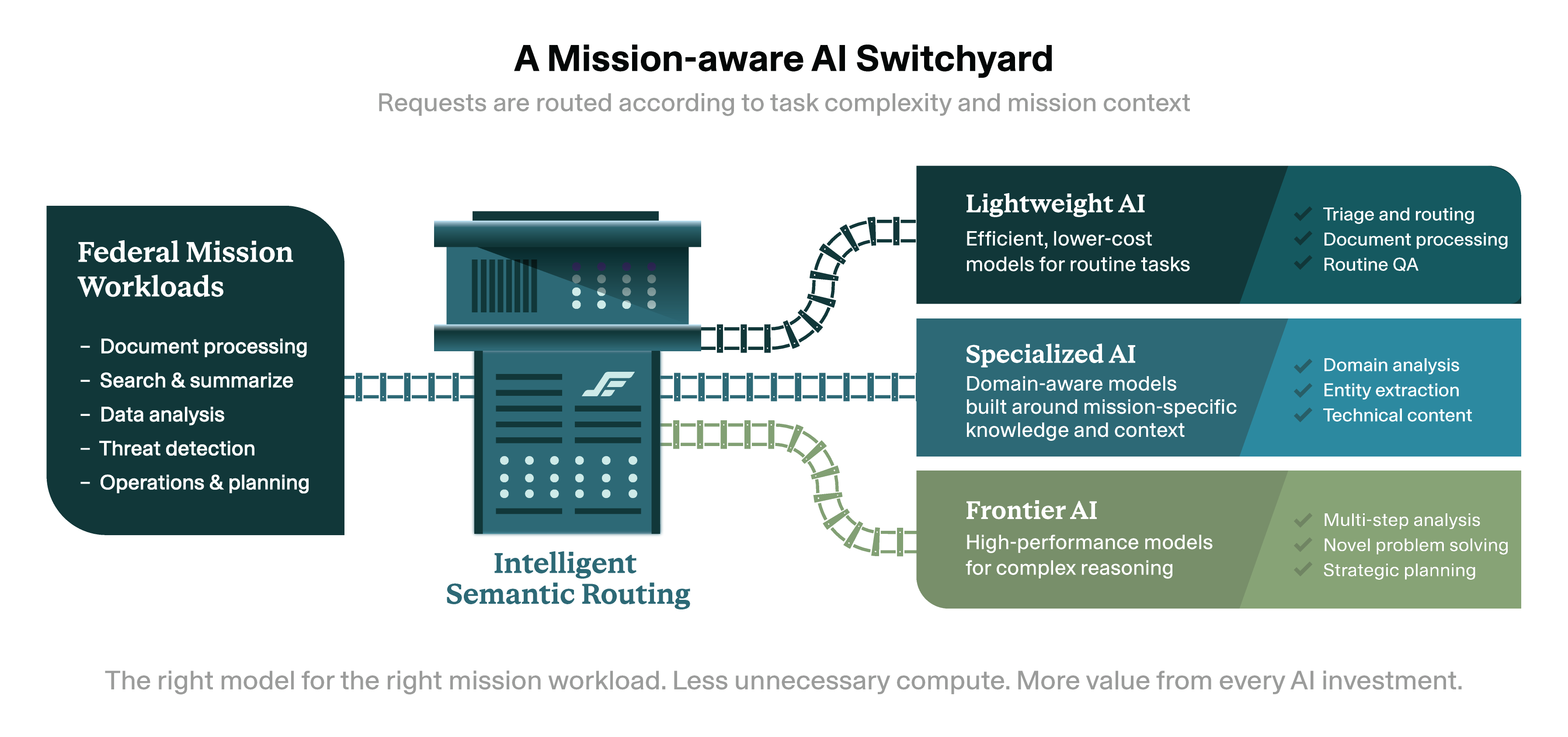
Effective mission operations depend on getting the right intelligence to the right people at the right time. A hybrid AI architecture supports that goal by matching computing power to operational needs, keeping routine processing closer to the mission while reserving larger models for more complex tasks.
Two approaches can help:

Keep specialized workloads local:
Deploying containerized models operating within secure agency boundaries can handle frequent, mission-specific tasks without sending every request to an external model. This reduces data egress, protects sensitive mission data, and eliminates API transaction costs.

Route requests based on need:
Use intelligent routers to optimize search, embeddings, and ranking locally, escalating requests to a larger frontier model only when needed. This automatically filters out routine queries, reserving expensive compute resources for complex task calls.
This hybrid approach helps agencies control unnecessary processing costs while protecting mission data and maintaining performance. More importantly, it supports timely access to the intelligence personnel need to make informed operational decisions.
Make Every AI Call Count
As federal AI programs mature, cost effectiveness will become an increasingly important measure of their ability to scale. Agencies need architectures that can sustain mission operations while delivering measurable value from their AI investments.
Vertical Intelligence, containerized models, and intelligent routing can help achieve that cost-saving balance needed to scale AI. By matching AI resources to operational requirements, agencies can control costs while maintaining access to the intelligence their missions demand.
At Everforth ECS, we see this as an essential part of delivering trusted mission operations: engineering AI around mission needs to improve efficiency, strengthen decision advantage, and sustain performance as demands evolve.
Enjoy Everforth ECS Articles Like This One?
Don’t Miss Any.

Everforth ECS Awarded $163M Contract Supporting DARPA MXO
Everforth ECS has secured a $163M DARPA task order to provide integrated technical and programmatic support to the Multi X Office, consolidating two task orders under one prime and building on more than three decades of MXO support.

Everforth ECS Secures NGA Contract Extension With Potential Value Exceeding $200M, Advancing Operational GEOINT Capabilities
Everforth ECS secured an up to two-year NGA contract extension with a potential value of more than $200 million to advance GEOINT AI interoperability, federation and adoption and enable decision advantage for the warfighter.