
How Everforth ECS Turns Technology into Mission Results
Government has more technology available than ever. The challenge is turning that technology into mission results.
Today’s missions are complex and rarely fit neatly into a single technology category. Agencies need partners who understand the mission, integrate the right capabilities, and stay accountable for the result.
At Everforth ECS, we start with the mission. Technology is the enabler. That distinction shares how we organize, invest, and show up for our customers.
We sat down with Donnie Scott, president of Everforth ECS, to discuss how this approach shapes the company’s strategy and what customers should expect from Everforth ECS.
Q: Government agencies have more technology choices than ever before. What do they really want from a technology partner?
Donnie Scott: They want outcomes.
When I talk with customers across defense, intelligence, and civilian agencies, they aren’t telling me they want more AI or more cloud. They’re trying to accomplish a mission, whether it’s the Cybersecurity and Infrastructure Security Agency (CISA) trying to protect critical infrastructure or the U.S. Army needing to secure hundreds of thousands of endpoints. A civilian agency may be trying to reduce fraud, improve the way it serves citizens, or lower the cost of operating. The technology matters because of what it allows the customer to accomplish.
That is where we start at Everforth ECS.
A lot of companies lead with a catalog of technologies. We start with the customer’s mission — who they serve, what they need to accomplish, and what is getting in the way. Then, we bring the right combination of cybersecurity, data and AI, application engineering, cloud and infrastructure, and enterprise platforms to address it. Those capabilities matter, but they are not the end goal.
Our job is to understand the challenge, pair it with the right people and capabilities, and deliver a result the customer can see.
Whether that means strengthening cybersecurity, improving mission decision making, or accelerating service delivery, customers don’t measure success by the technology they buy. They measure it by whether they are more secure, can make decisions faster, can serve people better, or can accomplish more of the mission.
Q: AI dominates almost every conversation today. How should government leaders think about AI?
Donnie Scott: AI matters, and we’ve been applying AI to government missions for nearly a decade. But AI is a capability, not a strategy.
The first question shouldn’t be, “Where can we use AI?” It should be, “What mission, decision, workflow, or risk are we trying to improve?” Then we apply AI where it creates a real advantage.
Technology will continue to change. New models will emerge, platforms will evolve, and another major innovation will eventually follow AI. That is the nature of this industry.
The constant is the mission. We have to understand where AI fits, where it creates measurable value, and where it does not.
That takes people who understand the customer’s environment — the mission, the data, the security requirements, and the operational constraints. A model that works in a demonstration but cannot perform in the customer’s real environment does not solve the mission.
That’s where we focus. We are not there to force a platform or chase the latest trend. We are there to solve the problem facing the customer and deliver a capability they can trust, use, and sustain.
Q: What makes Everforth ECS well positioned to deliver those kinds of outcomes?
Donnie Scott: It starts with our people.
We have deep technical expertise across a range of capabilities. But, technical depth alone is not what makes us different. Our people have spent years working alongside customers and solving some of their hardest mission challenges.
Our best teams become trusted members of the mission team. They understand the operating environment, take ownership of the hard problems, and stay accountable for the result. That commitment runs all the way through to our leadership team.
Being part of Everforth allows us to bring more to those missions. We bring stronger technology partnerships, experience from both federal and commercial markets, reusable software, automation, and greater investment. That means our team does not have to start from scratch every time a customer faces a new challenge.
It strengthens who we already are as a government partner. We show up as One Everforth around the customer’s mission. The customer should see that through faster delivery, less reinvention, lower risk, and more mission impact.
Q: How do technology partnerships fit into this strategy?
Donnie Scott: They’re foundational.
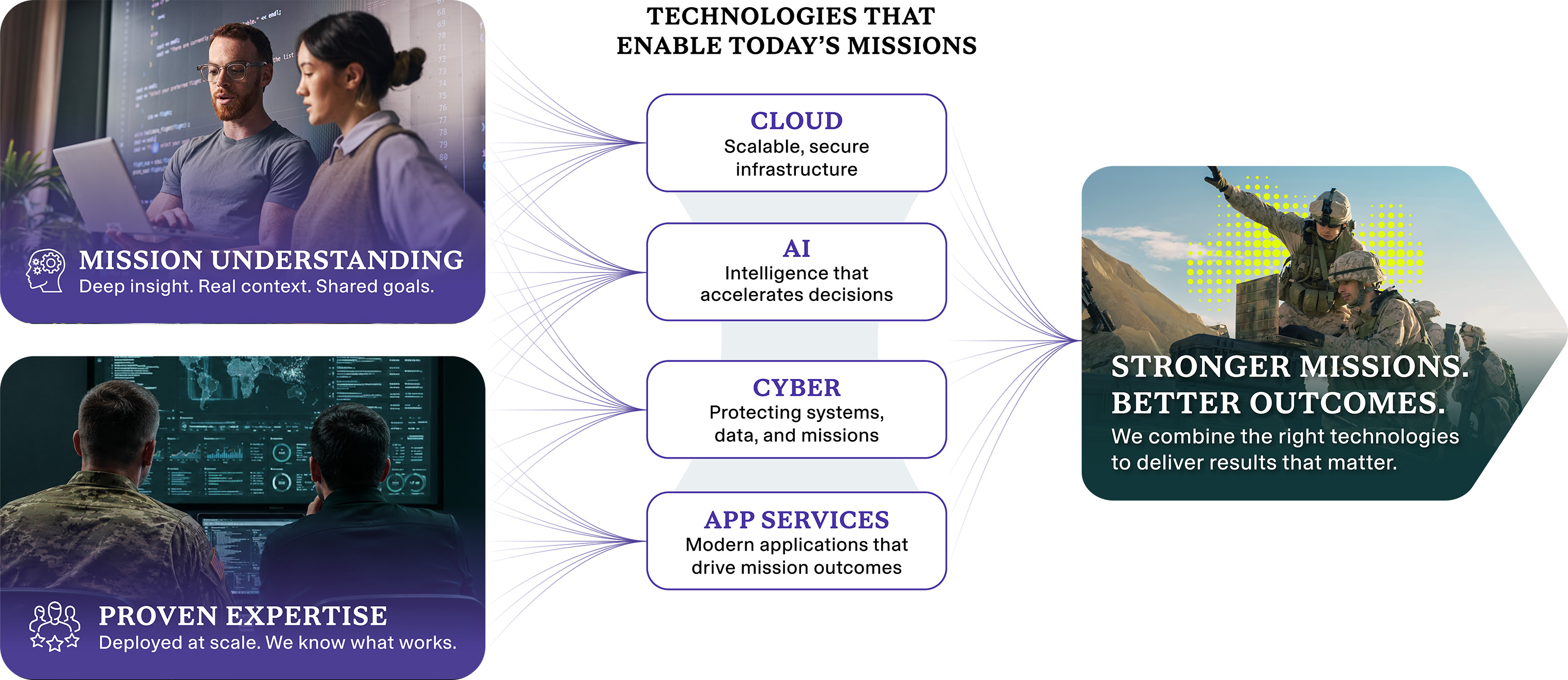
We have deep relationships with leading cloud, AI, software, and platform companies because those technologies enable today’s missions. But the relationship is only the starting point.
The difference is what you do with those technologies.
Our customers don’t need another company telling them which platform is newest. They need a partner who understands the mission, understands the available technologies, and can integrate them into a solution that works in the customer’s environment.
That’s where experience matters. We have deployed these technologies at scale. We know where they work, where they don’t, and what it takes to integrate them securely into a mission environment. That allows us to make better decisions with our customers, reduce implementation risk, and avoid simply recommending the latest trend.
We also bring our own reusable software, accelerators, and adapters to those partnerships. The goal is to get the customer to the outcome faster, not to begin every engagement with a blank sheet of paper.
Q: You often talk about delivering mission outcomes instead of technologies. What does that mean in practice?
Donnie Scott: It means we manage the mission result, not just the contract inputs.
Government contracts are often written around labor categories, technical requirements, and defined deliverables. That is the buying construct, but it cannot be the measure of success. The real measure is whether the work produces a meaningful result for the mission.
In practice, that means defining success with the customer, assembling the right team and capabilities, measuring progress, and staying accountable for the outcome — whether that is a strong cyber posture, better user adoption, faster application delivery, or improved decision making.
Trust is earned in delivery. We solve one hard problem, prove the result, and earn the right to take on more of the mission.
Once that trust is established, we can bring more of Everforth — our people, technology partnerships, reusable capabilities, and experience — to help the customer achieve a broader set of mission outcomes.
Every engagement should also leave the mission stronger than we found it, with better systems, reusable assets, improved processes, and knowledge that carries into the customer’s next challenge.
Start with the mission. Bring the right capabilities. Deliver the outcome. Talk with our team about your next mission challenge.
